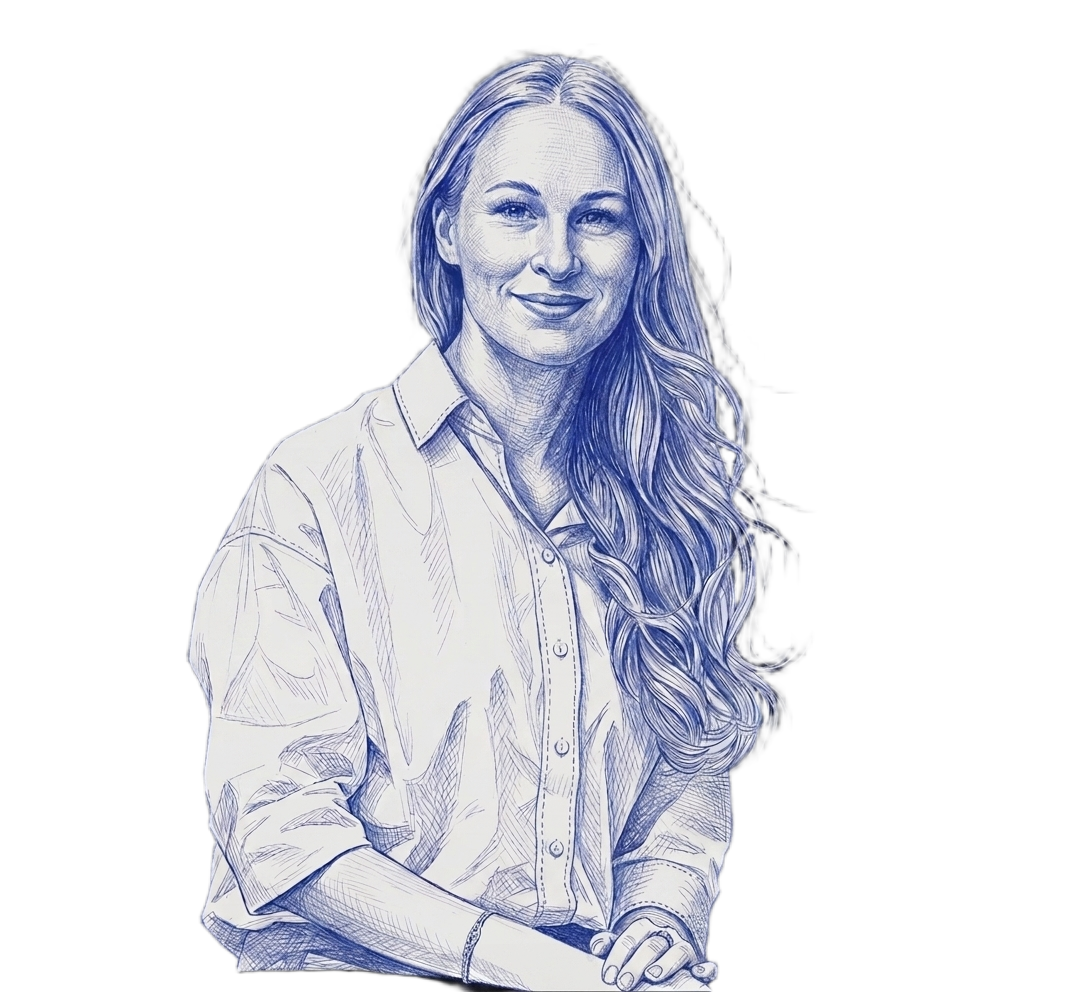
Erika Bondareva
CEO & Co-founder, auryx
Klaipėda-born, Cambridge trained biomedical engineer, Erika and the team launched auryx - and raised $2M pre-seed to build it
What is the promise of auryx — what problem are you set to solve?
Every major health wearable today is built on optical sensing, and while that has enabled a lot, it also comes with real limitations — shallow metrics, poor performance under motion, and a new device required every time you want a new health feature. The hardware fragmentation alone is becoming difficult to sustain.
We believe sound is a fundamentally overlooked sensing modality for health. The body is acoustically rich: heart, lungs, blood flow, all generate signals continuously. And almost none of that information is being used in consumer health technology today.
auryx builds machine learning models that extract health information from microphones already embedded in earbuds, turning devices people already wear into continuous, passive health monitors through software rather than additional hardware. For users, that means meaningful health monitoring without buying anything new. For earbud brands, it means unlocking health capabilities on their existing hardware without adding a single sensor.
Our broader belief is that sound will become a core sensing layer for preventative health, and we are starting with earbuds because the form factor is perfect: direct body contact, mass adoption, and the sensing hardware already in place.
Tell us your personal story: Lithuania to Cambridge to auryx
I grew up in Klaipeda, Lithuania, and moved to Glasgow at eighteen to study biomedical engineering. It was my first time in the UK, and my first real encounter with the Glaswegian accent — I remember sitting on the bus from the airport genuinely unsure if the driver was speaking English. The next summer, instead of going home like everyone else, I stayed and took on a door-to-door fundraising job with the sole purpose of improving my English. It wasn’t easy, but it worked.
Studying biomedical engineering in Glasgow was the first time things did not simply come easily. School had come relatively naturally to me, but Glasgow changed that quickly — if I wanted to do well, I had to become much more disciplined and consistent in how I worked. That lesson became more valuable than I realised at the time.
As part of my degree, I worked in R&D at a medtech company, which I loved, but I kept feeling like I had no real agency over what got built or why. Academia seemed like the place that offered that freedom, so I made a slightly stubborn (and perhaps naïve) decision: I applied to exactly one programme — the combined master’s and PhD in Sensor Technologies at Cambridge — and decided it was either that or nothing. Fortunately, I got in.
The master’s let me move across different faculties and disciplines, which is how I met Cecilia Mascolo, who became my PhD supervisor and eventually a co-founder of auryx. It is also where I met Kayla-Jade Butkow, our other co-founder. During my PhD I worked part-time at a startup and caught the entrepreneurship bug — I realised I love research deeply, but for me to stay excited about it, it has to leave the lab and reach real people. Once I understood that, the next step felt obvious.
How did your research in biomedical signal processing lead to auryx?
My research was focused on using machine learning to extract health information from acoustic signals — not tied to any particular device, but to the fundamental question of what sound can tell us about the body.
What kept surprising me was how much information is already there that we are simply not using. Cardiovascular signals, respiratory patterns, gastrointestinal activity — the body produces all of it acoustically and continuously, but most of that information is never captured or interpreted. At the same time, modern machine learning models can help extract subtle patterns from signals that are difficult for humans to interpret directly. The more I explored, the more the space kept expanding.
Kayla’s research, separately, focused on how in-ear microphones could be used to measure vital signs such as heart rate, respiratory rate, and cardiac output. My work approached the same broader question from another angle: how to extract clinically relevant cardiovascular information from audio signals. Over time, those two threads began to converge around the same idea — that sound could become a powerful new sensing modality for health, and that earbuds were the right place to start.
The moment it stopped feeling like an academic idea and started feeling like a company was a rainy evening in a Cambridge pub. Kayla and I were talking about the future of this problem space, and at some point realised that if we were ever going to build something, we would want to do it together. Cecilia, who had supervised both of us and whose research sits at the very foundation of this space, inevitably became a part of this conversation.
auryx grew quite organically from there. I am excited to now be building a company around the idea that first drove the research: that health monitoring can move into the devices people already wear every day.