.avif)
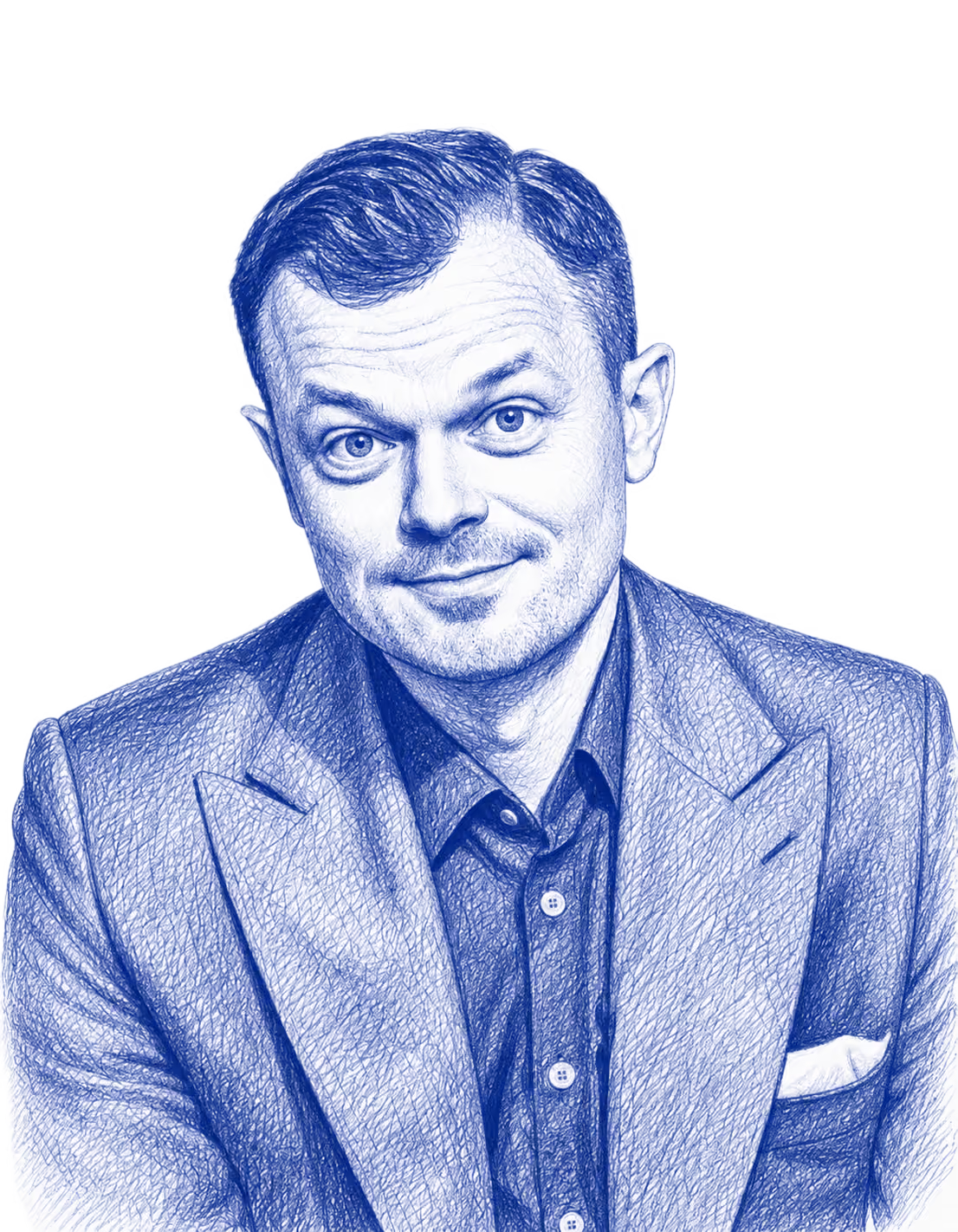
Avery Schrader
Founder and CEO, Modash
Modash is scaling rapidly, building infra for creator economy - led by relentless Canadian founder, who moved to Estonia to start a company
Modash is scaling aggressively — where's the company today, and what are your top priorities right now?
Modash is now used by more than 2,500 companies to build and scale creator partnerships. We're around 90 people, our revenue is already larger than all the money we've ever raised, and we grow faster every year.
I think the world kind of sees that the creator economy is the future, but even with ~$40B in spend growing ~30% annually, our space still feels early. All of your favourite brands partner with creators and want to find ways to deploy even more there. Unilever's new CEO famously said he wants "an influencer in every Zip code in the globe." Modash is going to own this space before everyone looks up and realizes it's the defining growth channel of the next decade.
The biggest priority at the moment is hiring the best possible people to build the next phase of the company.
To give a more practical set of challenges: our customer base is changing. More and more household names want to use Modash at a scale we haven't seen before. That's testing every part of our business, and there are some things we can't let slip even when it hurts like hell. We need to maintain a great customer experience, stay disciplined about hiring people who add momentum, and stay focused on the core problems we set out to solve.
To let any of that stuff slip while we grow will be an irreversible error.
You moved to Estonia to start a company with no contacts, no capital, and not even a real concept. Would Modash have happened anywhere else? And more broadly — should more founders be moving somewhere new for that kind of fresh start?
Estonia and Europe mattered a lot for Modash. If you're trying to scale something, you need to be in a place that gives you some advantage. The region offered close proximity to scaling consumer brands (Bolt, Wise, NordVPN, Wolt, Burga). It also had very little meaningful competition, and some of the problems we solved were more painful because of the fragmented markets here.
To keep finding that advantage, you'll almost certainly need to move at some point in the journey. Tallinn is my home base, but I spend more time in North America every year. We also relocated a founding team member to North America. He understands Modash as well as I do. Without him physically there, it would be unacceptable for me to be this far away from our largest market and our growing teams.
On a personal note: Estonia gave me a place to learn what it means to build a company. Being part of the ecosystem here was crucial for me. I had absolutely no clue what building a company meant, and being here with such a strong and supportive ecosystem gave me a chance to catch up.
So changing continents is underrated. For me it was important to learn that the perspective I formed growing up is a tiny portion of what the world actually is. It was also a great lesson in personal responsibility. The choice is always ours about what we do and where we are.
So I don't know if Modash would have happened somewhere else, but I'm pretty sure I would not have become the same founder somewhere else.
You ended up landing on "infrastructure for the creator economy" — a thesis that looks perfectly timed in hindsight. Was that foresight, iteration, or luck?
We build infrastructure for creator economy companies, and we help a whole lot of brands run creator operations. I think those particular bets were foresight, the timing was luck, and the implementation is a lot of iteration.
To give you an example of some of the things we knew that other people didn't, which are still true today:
- There are hundreds of millions of creators. Not just the 5 you think of when someone says "influencer." Many people would be shocked by how many interesting creators exist even in their own obscure hometown.
- Creators are much more like your brother and sister than they are like Kim Kardashian and Cristiano Ronaldo. They are normal people with hopes and dreams and fears and an urge to make things people like (much like founders).
- The competitors were mostly undifferentiated because they were more interested in growing short-term revenue than building products that solve real problems.
These simple insights have given us a huge advantage in the space. They change our internal motivations, the way we design and build products, the way we treat and support customers, and the complexity we are willing to deal with to build great products.