.avif)
work in progress
New Guardians. It was Feb 24, 2022 when Ukraine was invaded - and we all reacted with shock and disbelief. Newsletter didn't go that week. But very quickly, the tech community responded with support and donations, taking a firm stance. Next, we've seen multiple new startups launched to help Ukraine withstand aggression — and ramp up European capabilities. Some of the smartest founders pivoted to defence. New funds emerged in the Baltics. Here is how these new companies have grown since - and many are just accelerating now.

What this table excludes
- Impressively growing companies that have been started before the war (the likes of Milrem Robotics, Brolis Semiconductors (EUR 50M rev last year), NT Service, Redwire (ex Edge Autonomy), DefSecIntel Solutions, Astrolight, etc). We added KrattWorks since they were not in defence before - started as drone-based machine vision tech for firefighters.
- Well-funded new emerging players that will break silence. That's, off course, Frankenburg Technologies, Onodrim, as well as Baltic founders launched elsewhere, like Laelaps AI in Zurich.
- Revenues not visible - many of these firms have already passed last year revenues in 2026 - RSI alone was planning 3-4x expansion this year.
- The pipeline of new entrants - it remains strong, there are many more problems to solve. Keep an eye on Lendurai, BlackSwan Space, Mainline, PDKinematics, Valkyrie Dynamics, RIPPLC, Kondra, Ormia, TrackDeep, Zvook, and many more. Feels like every couple weeks founders like Paulius come around Linkedin.
Funding across Europe. Baltics truly stood out with new defence tech investing, including dedicated funds. Plural, ScaleWolf, Darkstar, Coinvest Capital, NGL Ventures, BSV Ventures, Iron Wolf, Superangel > Archangel – all these have important defence players in portfolio. Plural stands out with Helsing - Khaled as already there at seed (Plural put more with later rounds). Iron Wolf contributed both with Onodrim and UFORCE tickets.
The venture outcomes. Backing defence tech has been new in venture. Both GTM and exit conundrums leave some VCs puzzled regarding outcomes.
Distribution is not straightforward - defence startups do not win on product alone. Selling through a prime means inheriting its pipeline and cutting margins. Selling to Ukraine directly very complicated given the local industry that emerged, but that's where you get the fastest feedback loop in the world. National procurement budgets and processes are hard to navigate, especially for newcomers, and tend to favour local industry, primes and neo-primes.
Exit pathways point to two likely destinations. Stay a specialist and sell to a prime / neo prime, accepting a ceiling. Or attempt becoming neo-prime, where Helsing, Quantum Systems, Stark have already raised the capital that defines the tier - in billions. It's clear that this door is closing, and it was never fully open, still largest European economies have inherent advantage to build one. For most Baltic startups, the question is how much scale can there be remaining a specialist, and consideration of broadening the spectrum across software / hardware.

Beyond the guns. We are seeing the war from close-up, and our understanding of the defence has evolved. Baltics were reminded where we sit on the map, and that the only way to protect the future is to build deterrence at the level Singapore, Israel or Finland. This goes beyond military means, and that's why The Total Defence Association was launched by prominent tech founders (multiple tech founders supporting this, go donate here).
On technology side, we will see further diversification of solutions to protect societies: that’s why Repsense (designated now as Trusted Flagger), Vegvisir, Blackswan Space, Astrolight, AISPECO come into the picture. With current chat on AI potentially going rogue, anticipate further capability building up on emergency / first response.
Snapshot. Impressive how Baltic tech mobilized, huge respect for founders building in this space, and it is still early in terms of commercial traction — some large companies will emerge.
Scaling consumer. Playbooks from LT have arrived to Latvia - after sudden rise of Prime Prometics (grew 108% to hit 100M in revenue 2025), now Nutrimeg crosses EUR 100M revenue mark. Burga secures 20M grant for the new plant, which is a great deal for the ramp up. No external investment, scaling production and inventory with physical products - there is something to learn there.
Women in AI Lithuania and Association „Lyderė“ launched Vienaragės in AI — with a meeting Oct 16-17, sign up — great initiative.
People moves. Marius will lead Go Vilnius Business. Vytautas is now Head of Product at EnforceShield. Lukas (ex-Vinted and buycycle) is now Product Head at Hostinger. Karola to lead growth and marketing at Roleo. Burga has Mantas Velykis (Havas) and Aivaras Maceina (Dentsu) joining the company. Older moves surfaced – Tomas Dirvonskas and Edvinas Bartkus are technical staff members at Vestibule.
rounds and capital
Surfshark acquires Optery to strengthen privacy protection ecosystem - another significant move. We chatted with Dovydas just recently on their strategy.
Intu Diagnostics, founded in Leipzig by Dr Skaiste Arbaciauskaite and Dr Dirk Kuhlmeier, is developing an all-in-one diagnostic cartridge - and raised €1.1 million in a bridge round, bringing its total funding to more than €3 million. The round was backed by BSV Ventures and SAB.
Markus started Studdywise couple years ago, as a high school student - it has been sold to Opiq.
sponsors
Cloudvisor [launched a free tool that scans your AWS account like a solutions architect and finds mistakes before they become expensive. It's called Refraxion.]
Hostinger [online presence accessible to everyone worldwide, hiring]
Google For Startups [cloud credits up to $350K, faster growth]
Ovoko [join to transform Europe’s €30B+ used car parts market]
Oxylabs [Step into the world of web data gathering]
VIALET [Business accounts for growth, hiring]
Surfshark [Top 50 among fastest growing in EU, hiring]
Eldorado.gg [world’s largest in-game trading marketplace, hiring]
Eneba [join the marketplace 20M gamers love]
InRento [Investments in real estate projects with income, growth, and impact]
brand + design
Just stop it. Nike is leaving the S&P 100 after a nearly 80% slide. For someone raised on Nike ads, it's hard to watch it get eaten piece by piece by competitors. Bad business decisions, sure, but also a brand problem. Call it chasing the "Undecided Whale", neglecting your loyal core customers to go after a bigger audience that's only half interested. Nike made its best work as the underdog is a lesson to be learned from as our Baltic whales scale fast.
roleplay
Oxylabs - Head of Data, AI Enablement Lead
Hostinger - Chief Revenue and Analytics Officer, +senior roles
Ovoko - Head of Marketing, Product managers
Eneba - Heads: Finance, Accounting, Influencer+Affiliate
Eldorado - Data Scientist, Engineering Manager
Surfshark - Brand Strategist, Data Team Lead
VIALET - Backend Engineer,Transaction Monitoring Specialist
BirdyChat - Head of Product
SporSpot - Sales Co-founder
Noviti Finance - CMO
Pulsetto - CCO
Bored Panda - CEO of boredpanda com
CoinGate - multiple roles
*if you don't enjoy where you are, this helps answer - should I stay or should I go?
further insights
Daring Fireball. Vinted gets a mention from the great John Gruber, probably the most influential independent commentator on Apple, as it climbs the US App Store charts. Not bad for a market where, as Thomas Plantenga told 20VC, Vinted's early tests "horribly failed."
Big Tech, Big Screens. A24 just blew up the internet with the trailer for "You Can See Everything," featuring the infamous Elizabeth Holmes. There's more coming to the big screen this year: The Social Reckoning, the follow-up to The Social Network, lands in October, and Artificial, arrives at Christmas.
feature guest post
Anonymous reflections from a Lithuanian start-upper we received this week.
As part of my mid-life crisis I spent the last week in the desert in Nevada. Burning Man seemed like a lot of hassle - to get there, to survive and to get out alive.
During the endless dust storms I had a chance to reflect on the principles of Burning Man and a few map surprisingly well onto what makes startup ecosystems thrive:
1) Radical inclusion. Vilnius/Kaunas tech circles can be cliquey and small-world. Burning Man's ethos of "anyone can participate" pushes against insider gatekeeping — make founder events, mentor lists, and intros genuinely open rather than favour-based.
Reflection: who are we excluding at events? How to make sure that the guy/girl on their own at the next event is included?
2) Gifting economy. No transactions, no quid pro quo. Successful Lithuanian founders sharing time and knowledge without expecting board seats or advisory fees builds trust capital faster than formal programmes do.
Reflection: I think we're really good at this. How many more founders can start to give back to the ecosystem now that haven't already?
3) Radical self-reliance + communal effort, together. Burners bring what they need but build the camp collectively. That's basically "bootstrap your own venture, but show up for the ecosystem" — hackathons, shared office space, informal Slack/Discord groups where people troubleshoot each other's problems.
Reflection: I'm less handson with Slack groups so maybe we're good at this too. What are the gaps in our ecosystem where peers could help solve problems?
4) Decommodification. Not everything needs a monetisation angle immediately. A culture that tolerates experimentation, side projects, and "useless" prototypes without pressure for a business model is often where the real innovation seeds come from.
Reflection: TBH I have more problems monetising some projects; is patience to allow monetisation to emerge a virtue?
5) Immediacy and participation over spectating. Burning Man has no audience, only participants. A startup scene that discourages passive conference-attending and pushes people to actually build, demo, and get hands dirty grows faster than one built on panels and PR.
Reflection: Lithuanians are task focused doers. I'm not worried about this one. The question is how to empower more entrepreneurs to knock down that first wall?
6) Leaving no trace, but building permanent structures anyway — the tension there is instructive too: Burning Man is temporary by design, but its organising principles persist year to year.
Reflection: Is pre-seed funding as abundant as it has been in previous years? Which parts of our startup energy (event-driven excitement, hackathon spikes) are temporary versus which infrastructure (funding networks, mentor pools, alumni ties) needs to persist between the spikes?
Final thoughts:
A week in the desert was a blast. It was worth the hassle and like most things in life, the more you put in the more you get out. There were at least three LT camps at Black Rock City this year, we have some cool ideas for next year too...
The biggest transferable lesson to the startup ecosystem is probably this: Burning Man works because of dense trust and voluntary contribution in a small, self-selected community — which is exactly the advantage a small country like Lithuania already has over larger, more anonymous ecosystems. The move is to lean into that intimacy rather than try to copy Silicon Valley's scale-driven model.
Thanks for taking the time to read this.
*have something to say? send us a message.
ecosystem
high-impact potential? these
Launch of Total Defence Association and tech companies supporting their colleagues going to military service (list is long by now, many top scaleups)
Teisora.lt - accessing public data via MCP (laws, procurement infos, court decisions, etc etc)
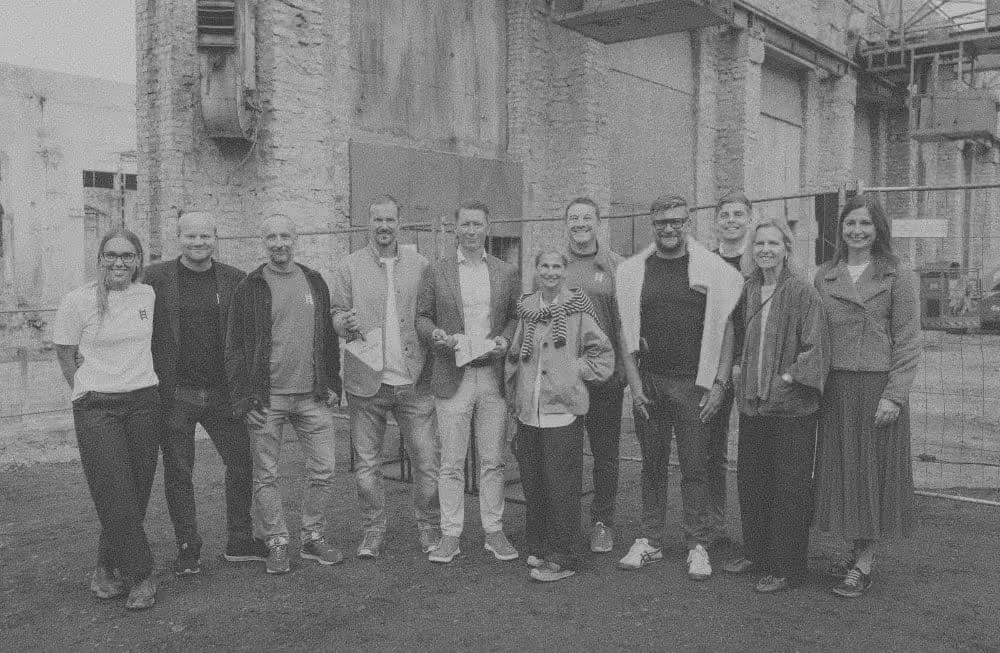
Construction starts at Kasvuhoone - inside a machine hall built in 1899, Kasvuhoone will bring together startups, accelerators, and community initiatives on 15,000 square metres. Congrats Skaala!
.png)